
Photo by Aleksandrs Zeltisevs
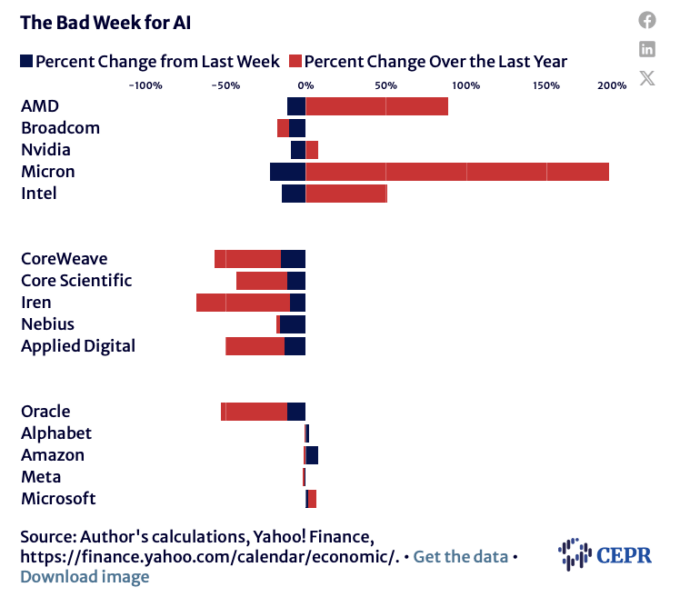
It may be too early to start the celebration, but some of the AI stocks took a big hit last week. But not all companies were hit equally. The biggest hits by far went to the neo-clouds, with several of the large chip makers also getting seriously whacked. The hyperscalers seemed little affected.
To give some of the numbers: CoreWeave, the largest of the neo-clouds, fell 15.4 percent, bringing its year-over-year (YOY) decline to 56.6 percent. Iren lost 9.7 percent and is down 67.7 percent YOY. And Nebius had the worst week, dropping 16.0 percent, pushing it down by 18.3 percent over the last year.
Among the chipmakers, Micron had the worst week, losing 22.0 percent of its value, but it’s still up 189.5 percent YOY. Intel also had a very bad week, losing 14.4 percent of its value, but is up 51.2 percent YOY. Nvidia’s stock plunged 8.8 percent but is only down 0.8 percent over the last year.
The hyperscalers were little affected by the end of the week, although Alphabet did take a sharp plunge the day after the election. For the week as a whole, its stock was up 2.1 percent. Amazon was up 7.9 percent, while Microsoft’s stock rose 1.7 percent. Meta took a small dip, losing 0.8 percent of its value.
Only Oracle, by far the smallest of the hyperscalers, and the only one without a hugely profitable non-AI business to rely upon, took a large hit. Its stock fell 11.2 percent last week and is down 52.4 percent over the last year.
At the risk of assigning too much rationality to financial markets, there is a story that can be told reconciling the disaster hitting the neo-clouds with the happy week enjoyed by the hyperscalers. The tales of AI not possibly paying off in the way its promoters promise has been widely circulating for months. But the new information last week was national elections in which people across the country and across party lines came together to say they hate data centers. This means the prospects for a mass buildout of data centers for the rest of the decade and beyond are looking much bleaker.
This is naturally going to hit the neo-clouds hardest because that is what they do. They now are looking at a situation where their ability to build more data centers will be sharply curtailed. If they do build them, they will almost certainly be required to meet far more stringent environmental conditions. They will also likely be forced to make considerably higher payments to local communities to offset their impact on water and energy usage. This means that they will be much less profitable, even if there is demand for their computing power.
The story with the hyperscalers goes the other way to some extent. While they are moving into data center construction in a big way, this is still not the bulk of their business. The rush into building data centers was forcing these hugely profitable companies to borrow huge sums, as their investment is now outrunning their cash flow.
Last Tuesday’s blue wave increases the likelihood that they cut back on their plans for a massive data center buildout, thereby curtailing their need to borrow in the years ahead. If it is increasingly looking like these data centers are not going to pay off, it is good news for these companies that they might be blocked from taking this path.
One item pointing in that direction was Microsoft’s announcement that it was canceling an agreement with Oracle to rent computing power. It apparently does not believe it needs the capacity. This comes two weeks after Microsoft cancelled a major data center project in the UK. This was ostensibly because it was concerned about being able to get sufficient power for the data center, but if Microsoft really wanted the data center, presumably it could have found a way to ensure a secure power supply.
Any turn away from the massive data center buildout may come too late for Oracle. It already is too deeply committed, and, unlike the other hyperscalers, it has no other lines of business providing enough revenue to keep it alive, despite a seriously mistaken investment. Its long-term debt offers yields well into junk range, with the longest issue paying more than 8.7 percent.
The chipmakers are a mixed story. Their stock prices exploded as the neo-clouds and hyperscalers were buying every chip they could. That story will be changing if plans for data centers really are being curtailed, but how far and how fast remains to be seen.
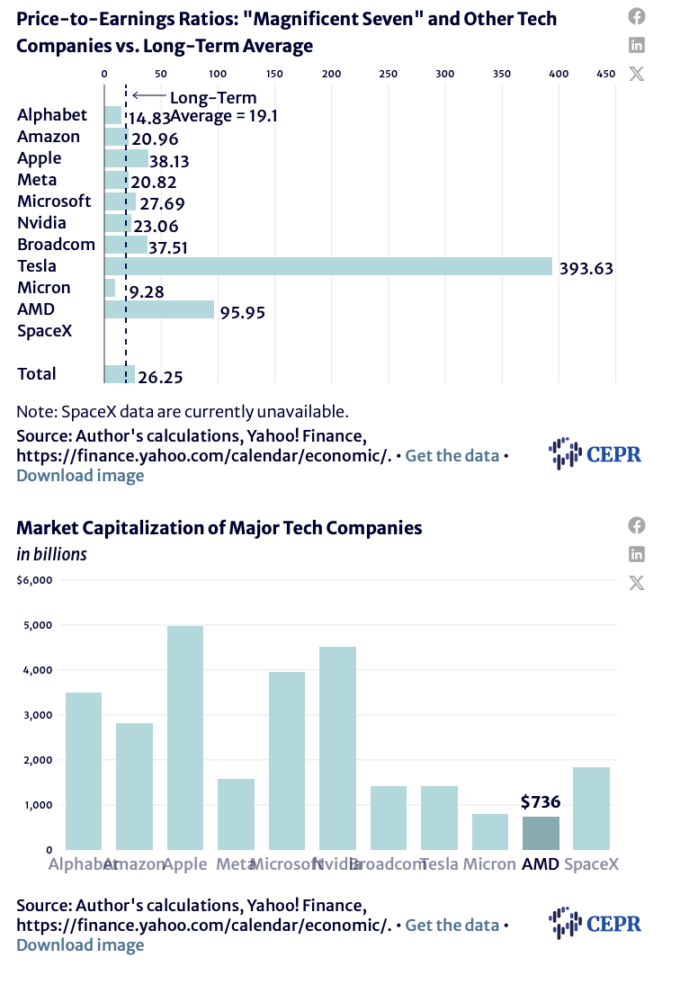
One early clue will be the data on prices for computer products and components that will be released with the Producer Price Index this week. After falling for decades, this index has been rising at a double-digit rate for the last year and a half. If inflation in this area begins to slow, it will be a clear indication of weakening demand. With the stock of most of the leading chipmakers selling at very high PEs (price-to-earnings ratios), they have far to fall even with a modest slowing in demand. These stock prices assume the continuation of high double-digit annual growth.
If the Democrats’ landslide on Tuesday hastens the collapse of the AI bubble, it will have provided a major service to the country and the world. It’s too early to make any definitive judgments, but there were some promising signs last week.
And with that, here are the latest numbers:
This first ran on Dean Baker’s AI Bubble Monitor blog.